Horse Training Tips – Is Your Horse Half-Brained?

Horse and rider“Is Your Horse Half-Brained?”

I remember being called ‘half brain’ when I was younger.

The reason for that was my ‘not so smart moments’ in life like when I forgot to shut the front door as I left the house or a dozen other things.

[With my kids in the 12 – 18 year old range I call  it the “teenage minds of mush” syndrome.  Relate?]

Believe it or not, horses are half brained much of the time and it can work against you if you’re not aware of it.

Here’s what I mean.

As you know, horses have an eye on each side of their head.

The right eye can see what’s going on towards the front of him, to his right, and behind him on the right.

His left eye takes care of the other side.

Thus, one eye can see what’s happening on one side of his body ‘independently’ of the other eye.

Us humans do not have that ability.

Do you know what that means?

That means ‘half’ of his attention is assigned to one eye.  The other half of his attention is assigned to the other eye.

That means half of his brain is with one eye and the other half is with the other eye.

Why is that important?

Because when you’re working with your horse and you’ve only got one of his eyes on you…

You Only Have
Half Of His Attention!

If you don’t have his attention, you don’t have the horse.

What’s curious to me is a lot of people don’t understand this.  Or if they do, they don’t seem to mind the horse doesn’t give them full attention.

But it’s crucial to have it if you’re going to teach your horse something.

Not only that, I find it totally disrespectful to NOT have someone’s attention when I’m talking – and that goes for horses too!

Have you ever had a conversation with someone and as you talk they look away, or act uninterested, or keep looking at their watch?

That’s rude!

Although I can’t do much about a person being rude, I certainly can with a horse.

And when a horse isn’t giving me his attention, it’s rude.

After all, I’m not asking them to give it to me all day.

They have 23 hours a day to eat, meander, run, etc….but when it’s my time – I want ’em giving me attention.

And if I only get one eye, then I’m not getting ALL their attention.

Now there are many times you won’t always get both eyes.

After all, if you’re lungeing a horse you’ll only get one eye because he’s circling around you.

BUT!!!

He can still focus most of his attention on you while lungeing.

And he should.

But remember, a horse’s attention span isn’t all that long and they have to be reminded to give it to you.

The younger the horse, the shorter the attention span. (Generally speaking)

How do you get your horse’s attention back on you if you lose it?
Make ’em move.

Create a little pressure.

Now why is this important?

Well, a horse ignoring you is bad manners for the horse.

A horse, like kids, must have good manners. Giving you attention is part of good manners.

But also, to train a horse you must have his attention.

If he’s going to be responsive to what you ask him to do, you have to have his attention.

What I just told you about how the horse’s brain works and how getting both eyes gives you both sides of his brain…which gives you his attention… is a significant part of understanding the horse.

If you have ever wondered to yourself, ‘Why does my horse do X ? ‘, then it may be there’s something about his nature you don’t know…but should.

In all my encounters with horse trainers, there’s one thing (among others) that we consistently agree on.
And that is…

‘To be successful with horses,  you must understand their nature.’

Makes sense, really.

After all, if you’re going to be a surgeon, you must know how the body works so you can repair damage and keep it working.

If you’re going to be an auto mechanic, you must know how engines work to fix them.

If you make engine repairs that are inconsistent with how an engine works, you will fail.

Training your horse is much the same way.

You MUST know how it works, thinks, acts, reacts, and so on.

There are lots of books on the subject if you want to read and study up on it.

Jesse Beery figured this our real early when he was learning horse training and developing his training methods.  You can see more about his training course here:

http://horsetrainingresources.com/beery.html

Or, you can take advantage of many of our excellent training videos by one of our professional trainers here:

http://horsetrainingresources.com/DVD.html

Remember…

The more you know about your horse, the better you’ll be.

That’s the big difference between people who are mildly successful versus those who can get their horses doing amazing things.

Knowledge.

It begins with understanding the nature of your horse.

Ok… that’s it.

Stay safe out there with your horses.

Charlie
Posted in General, Horse Training Tips, Horse Training Videos, Horseback Riding | Tagged , , , | Leave a comment

Horse Training Tips: Want Your Horse To Stop If This Happened?
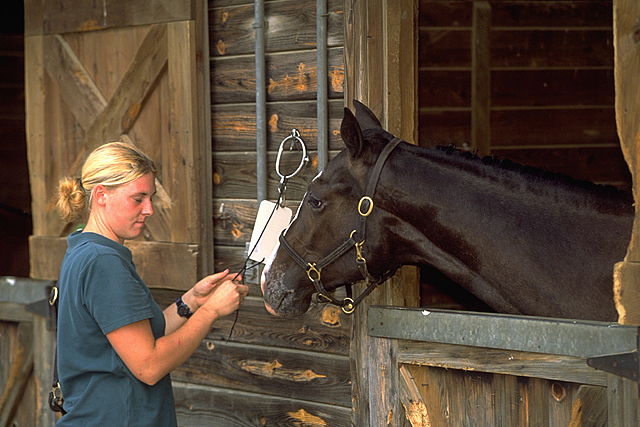
Woman training horse Want Your Horse To Stop If This Happened?

In rodeo competitions, the rider chases a calf.   The horse zooms up next to the calf, and at the right moment, the cowboy slides off his horse, onto the calf, and the wrestling match begins.

The horse is trained to do run up to and along side the calf so the cowboy can do his thing.

But what if you’re not as good at riding a horse as these guys?

What if you have a son or daughter who you worry about falling off the horse and the horse doesn’t stop?

That would be especially bad if a foot was caught in the stirrup.

Ouch.

Would you rather have a horse taught to stop or slow down if you’re falling off?

Why would you want that?

Well, if you’re not a rodeo-er or into Dressage, etc., then chances are you’re more into trail ridin’ and easy goin’ stuff.

T’ain’t nothin’ wrong with that.  In fact, that’s a very big portion of the horse industry today.

So if you’re not an experienced rider, break easier ‘n you used to, and want your horse to stop if you fall off or maybe even  slow down if he feels you slipping, that can be done.

Diana Quintana, one of our featured trainers, teaches that very thing to horses.

See Diana Quintana’s DVD

She’ll take a ‘deflated innertube’ (with the stem removed) and put it on a horse.

She’ll start by having the horse walk around with it on. Not trot or lope…walk. (I might add the horse may need to get used to it being on his back first.  You can’t always throw it on and go.)

Anyway, once the tube is on, have the horse walk a calm, steady pace.

As he does, watch for the inner tube to come off… because it will.

As it starts to slip, the horse will notice it.  That’s the horse’s cue…when it starts to slip.  That mimics a rider starting to slip off.

Then when the tube hits the ground, stop the horse.

And once it’s on the ground around the horses feet, you want him to accept it and not freak out about it.

You want him calm and cool about it.

Why?

Because you always want your horse to remain calm and cool regardless of the situation.  That way, you don’t have to fight a thousand pounds of out-of-control muscle.

Instead, it’s taught self control.

When you get him doing this well at the walk then you can go to the trot – but not until then.

Now there’s a little more to it than what I told you because words don’t do it justice, some things ought to be seen for clarity.

But you get the gist.

And if you haven’t yet seen Diana’s video, you might take a look at it.  To read about it, click the following:

See Diana Quintana’s DVD

Posted in General, Horse Training Tips, Horse Training Videos, Horseback Riding | Tagged , , , | Leave a comment

Horseback Riding: Benefits of Horse Ownership
horse care stableHorseback Riding: Benefits of Horse Ownership
Ever feel the need to justify having horses?  While they’re lots of work – it is generally very fulfilling work and enjoyable – especially when you and your horse have built a good relationship.

Anyone who has raised, trained and cared for horses understands this well.   What follows is an excellent article from Dr. Depew of the LSU AgCenter.  As usual, Dr. Depew gives solid insight and I couldn’t agree more.

Here’s  his message:

Horse ownership can be very exciting and rewarding. The primary reasons for horse ownership are companionship, recreation and relaxation, says LSU AgCenter animal science professor Dr. Clint Depew. “Many young people have developed their confidence and self-esteem through horse ownership,” the LSU AgCenter equine expert says, noting that horse projects tend to be a family activity, which yields many benefits because of family interaction. “Horse ownership is a very desirable and positive self-enhancement activity,” Depew says.

The responsibility for daily care and management of the horse comes with horse ownership. Horses need to be groomed, exercised and fed daily. Their stalls and surrounding areas need to be cleaned and maintained.

The initial investment in the horse is only a small portion of the actual cost of ownership Depew points out, cautioning, “When considering the purchase of a horse, weigh the benefits against the cost and responsibilities carefully.” He says before purchasing a horse, it is advisable to take riding lessons and/or work at a riding stable to assess your interest and commitment.

“Spending time with horse trainers and attending horse clinics will give you an opportunity to learn the skills needed to care for horses and evaluate your desire for ownership,” the LSU AgCenter horse expert says, adding, “You should talk to horse owners, trainers and county agents about the cost of maintaining a horse.”

Depew says the average horse will need a minimum of 2 acres of pasture to provide adequate forage to meet its nutritional requirements. Some type of shelter is needed and facilities for tack, feed and hay. A wash area is needed for grooming and a trailer for transportation. By assessing the cost of horse ownership and gaining experience with horses, potential horse owners can make informed decisions about purchasing horses.

When buying a horse, buy a horse that fits the rider and the rider’s goals, Depew advises. For example, it is important that inexperienced riders purchase an older experienced horse to learn on. Older horses generally make fewer mistakes and will tolerate more errors by the rider. Young horses are less predictable, more strong willed and require a more experienced rider.

Generally geldings are steadier and more reliable than mares. If trail or recreational riding is the desired goal, an experienced trail horse should be purchased.

“It is always advisable to obtain professional help when purchasing a horse,” Depew says. Assistance determining the horse’s temperament and ability will require an experienced horseman. Look at the horse several times and in different situations to judge ability and temperament. With good help and a proper evaluation, most errors can be avoided, and a suitable horse can be purchased.

After the purchase, Depew recommends taking regular riding lessons to improve your skill and knowledge. “You will need good equipment and tack to have a safe riding experience,” he says, adding, “Establish a rapport with a veterinarian, a farrier and local trainers to have an appropriate support team for your horse project.” LSU AgCenter parish agents also have information about horse care and feeding.

“If you purchase an appropriate horse and learn to ride and care for your horse correctly, you will enjoy many years of enjoyable horse ownership,” Depew affirms. “Good luck with your horses.”

—————–

Want a great book to get you started?

Take a look at “Horseback Riding: The Complete Beginner’s Guide”.

It teaches all you need to know before you get started in expensive lessons.  Hundreds have used it successfully to start learning at home and then will start formal lessons when they have come up to speed.

Posted in General, Horse Training Tips, Horse Training Videos, Horseback Riding | Tagged , , | Leave a comment