My Horse Won’t Stand Still!

 “My Horse Won’t Stand Still!”

First – I got a nice note form Lucy:

+++++++++++++++++++++++++++++++++++++++++++++++++++++++++++

“I’ve been getting your daily emails for a while now and i
just wanted to say what help they have been.

i have a 4 (nearly 5) year old welsh who is lovely in
every way but is sometimes a bit spooky out hacking and some
times forgets who’s the owner.

with your emails, i have learnt a lot on how to control him
and teaching him new things. as i was told before, a horse
never stops learning.

he’s come on leaps and bounds and i wanted to thank you once again.

keep it up and a note to other horse owners with problem horses:

Keep trying. a dream is the hardest thing to achieve. but
when you have it, it’s Amazing.

thanks again,   Lucy and Toby x”

+++++++++++++++++++++++++++++++++++++++++++++++++++++++++++

A common question I get is:

“What do I do when my horse won’t stand still?”

Horse won’t stand when mounting and, in many cases,
the horse won’t stand still for anything – mounting,
grooming, saddling, picking up his feet, etc.

This is a common problem and may have a few different causes:

1. First – training, or lack of training.  I’m not trying
to be cute but many horses simply haven’t been trained to
stand still when mounting.  They start to move once you
place weight on the stirrup or start to put the saddle
blanket on, etc.  If you continue to let them get away
with it then it forms a bad habit and they will always do it.

In short – they have conditioned YOU to put up with it!

2. The second cause could be due to discomfort.  If your
horse has sore muscles, saddle sores, poor-fitting tack,
etc. then the horse may be reacting to the discomfort.

Remember – horses will tend to move away from pressure
or pain.  (Wouldn’t you?)  If they’re moving when you mount
it might be due to discomfort.

Make sure your tack fits right, the horse doesn’t have
lumps or sores, and that the girth and cinch are done properly.

Mounting, especially when using a Western saddle, puts a
lot of pressure on the horse and the twisting and pulling
is throwing the horse out of balance.  You can imagine
that it’s somewhat natural for the horse to react to those
pressures if not trained to stand.

So… assuming it’s not a physical problem with the
horse and not a tack problem, let’s examine how we
can keep your horse from moving while mounting:

Remember – teaching a horse anything is the process of
forming good habits and impressing upon them what is right
and wrong through positive feedback or working them.

If you ask a horse to do something and they do it, you
reward them with good words, pats and gentle strokes.
If they do not do what you ask, you have them do work
or inflict pressure and then try it again.  This is basic
horse training 101.

After they do the work or you let up the pressure, you
ask them (or lead them) to what you want them to do again.
If they do it, you reward them.  If they don’t, you work
them again.

Sort of like ‘wash – rinse – repeat’.

Some horses require more work than others.  They all have
different dispositions and react to different training
methods (just like my 5 kids!).

If your horse starts to move when mounting then one
way to handle it is to not finish mounting, take the
horse and work it in the round pen a minute or two and
then try to mount again.  If the horse continues to move,
work the horse again.  Eventually, the horse will get
the message – if I move, I get worked.  (Wash – rinse – repeat).

However, at the point the horse doesn’t move then
reward him right away.  You can do this in steps –
put your foot in the stirrup and start to apply weight,
then get off and reward him.  Next, put more weight on,
but don’t fully mount, dismount and reward him.
Again – reward positive actions.

This process works for many horses but takes time.  And
you have to continue to reward the horse each time
you mount to fix the positive habit.

But what do you do with the horse that won’t stand
for anything due to his disposition or past problems?

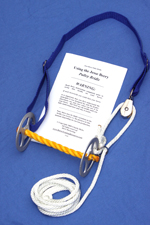
Prof. Beery’s Pulley Bridle – it is so effective for
so many problems it is worth having.  It is adjustable
for almost any size horse and is simple to use.

Using the pulley bridle, you can quickly cure a horse
from multiple negative habits.  The method is so effective
due to applying pressure on top of the neck right behind
the ears.  There are exposed nerves there that will
literally stop a horse in his tracks if the pressure is
applied properly (and MUST be used properly).

In many cases only a couple quick jerks on the lead rope
of the pulley bridle will completely cure the horse.  And,
it works great to teach a horse to let you lift its feet,
from shying at various things, teaching it to follow you,
backup, etc.  It’s a tremendous training aid.

I would suggest most first-time users to have an assistant
with them when using the Pulley Bridle for the first time.

The pulley bridle is a great time saver since it
is so effective.

You can read about the pulley bridle here:

http://www.horsetrainingresources.com/bridle.html

The bridle comes with full instructions and examples of
use for various bad habits.  Be sure to read the instructions
before using the pulley bridle.  It is to be used for
training purposes only.

Honestly, with the combination of the “Jesse Beery 8 Volume
Course on Horsemanship” and the Pulley Bridle, you can solve
95% of your common horse problems.

If you will take the time to read and study the horse
training methods in the Beery manuals and use his
methods as he describes, you WILL be able to solve
your horse problems.  Guaranteed.

http://www.horsetrainingresources.com/bridle.html

Take time to train your horse…  your efforts will be
well-rewarded.  Both you and your horse will enjoy each
other so much more.  How long will you continue to put
up with a horse that has many bad habits?

Enjoy your horses….please do it safely.

Charlie

P.S. Did you know that you can get 20% off our books, bridles,
and bits (including all bundles) and 30% off DVDs when you
subscribe to The Horse Library?

http://www.thehorselibrary.com/

The primary reason to subscribe is to access the online videos,
all the books, articles and misc things there.  And it will be
growing each month.

Check it out – click on the all the menus to see what’s there.
Get in now and you’ll be locked in to that price as long as
you stay a member.

http://www.thehorselibrary.com/

“Nothing positive changes with horses (or life in general)
until you take action.”
Posted in General, Horse Training Tips, Horse Training Videos, Horseback Riding, Testimonials | Tagged , , , , , | Leave a comment

Would You Want Your Horse To Stop If This Happened?

1. Would You Want Your Horse To Stop If This Happened?

2. The Horse Library – A Wealth of Horse Training
Information at a fraction of the cost you’d normally
pay.

++++++++++++++++++++++++++++++++++++++++++++++++
Here’s a couple recent comments from folks:

“Your uplifting words always give me new
ideas for working with my horse. Thank you!”

“I really enjoy reading the mail I receive
from you. It is very informative with a
sense of humor at times.”

Thanks for the notes.  We appreciate getting them.
— Charlie
++++++++++++++++++++++++++++++++++++++++++++++++++

1. Would You Want Your Horse To Stop If This Happened?

In rodeo competitions, the rider chases a calf.
The horse zooms up next to the calf,
and at the right moment, the cowboy slides off his
horse, onto the calf, and the wrestling match begins.

The horse is trained to do run up to
and along side the calf so the cowboy
can do his thing.

But what if you’re not as good at riding
a horse as these guys?

What if you have a son or daughter who
you worry about falling off the horse
and the horse doesn’t stop?

That would be especially bad if a foot
was caught in the stirrup.

Ouch.

Would you rather have a horse taught to
stop or slow down if you’re falling off?

Why would you want that?

Well, if you’re not a rodeo-er or into
Dressage, etc., then chances are you’re
more into trail ridin’ and easy goin’ stuff.

T’ain’t nothin’ wrong with that.  In fact,
that’s a very big portion of the horse industry today.

So if you’re not an experienced rider, break easier
‘n you used to, and want your horse to stop if you
fall off or maybe even slow down if he feels you
slipping, that can be done.

Diana Quintana, one of our featured trainers,
teaches that very thing to horses.

http://horsetrainingresources.com/dvd-dianaq.html

She’ll take a ‘deflated innertube’
(with the stem removed) and put it on a horse.

She’ll start by having the horse walk around
with it on. Not trot or lope…walk. (I might
add the horse may need to get used to it being
on his back first.  You can’t always throw it
on and go.)

Anyway, once the tube is on, have the horse
walk a calm, steady pace.

As he does, watch for the inner tube to
come off… because it will.

As it starts to slip, the horse will notice it.
That’s the horse’s cue…when it starts to slip.
That mimics a rider starting to slip off.

Then when the tube hits the ground, stop the horse.

And once it’s on the ground around the horses
feet, you want him to accept it and not freak
out about it.

You want him calm and cool about it.

Why?

Because you always want your horse to remain
calm and cool regardless of the situation.  That
way, you don’t have to fight a thousand pounds of
out-of-control muscle.

Instead, it’s taught self control.

When you get him doing this well at the walk then
you can go to the trot – but not until then.

Now there’s a little more to it than what I told
you because words don’t do it justice, some
things ought to be seen for clarity.

But you get the gist.

And if you haven’t yet seen Diana’s video,
you might take a look at it.  To read about
it, click the following:

http://horsetrainingresources.com/dvd-dianaq.html

============================================================

2. The Horse Library – A Wealth of Horse Training
Information at a fraction of the cost you’d normally
pay
.

As most of you know, we launched The Horse Library
website a week ago.  Lots of folks took advantage
of the Charter Membership – -thanks.

We’re already planning quite a few additions to the
articles and to the “Resource Videos” selections.

In fact, we’ll be reorganizing the articles into more
categories since we’ll have too many to list in a single
column.

I have recently secured distribution rights to some
old movies that are horse related and we’ll be putting
those up as we have a chance to get them converted.

http://www.TheHorseLibrary.com/

So what?  Well, for those who acted quickly they are
locked in at the low Charter Membership rate.

For those who act now, the Gold rate is still an
extremely good bargain when you get a chance to see
all the content that is in the Library!

Over time, as the Library grows, we’ll continue to
raise the price.  However, anyone who subscribes early
will always be guaranteed the rate they signed up at.

It only makes sense – we want to reward those who
act early.

Plus – don’t forget – members of The Horse Library
also get 20% off our products and 30% off all our
DVDs (except “any Horse, any Rider”).  Just another
benefit of being a member.  And we have a few
surprises for you in the coming weeks as well!

If you haven’t looked at The Horse Library then I
would urge you to at least jump over there and see.

Run your mouse over each of the menu items to see what’s
there.  I think you’ll agree that, for the volume of
books, articles, and videos there there’s no better
value on the net for professional horse training info.

http://www.TheHorseLibrary.com/

Ok…that’s it for today.  Stay safe around your horses!

Charlie

P.S. Remember – you can save 20% on all videos for the
next few days.  Use coupon code VIDEO on the checkout page.

Posted in General, Horse Training Tips, Horse Training Videos, Horseback Riding, Testimonials | Tagged , , , , , | Leave a comment

The Important Parts Of Your Horse You Must Be Able To Move

***********************************************************
   1. New Service To Launch Tuesday –
You’ll Want Be Ready!

2. The Important Parts Of Your Horse
You Must Be Able To Move

************************************************************

1. New Service To Launch Tuesday –
You’ll Want Be Ready!

I’ve been hinting at a new service we’ve been developing.
After months of work, we’re about to release it to the
world.   Over the next few days we’ll be releasing more
information and it will go live on Tuesday, May 5th.

Imagine walking into a library and having access to a
whole host of material including videos, books, articles
etc.  Got it?  Now think of accessing this library from
anywhere on the planet where you have Internet access.

Here’s a bit more info:

1. You’ll be able to watch selected, FULL-LENGTH videos
online.  Each month we’ll add different videos.

2. You’ll have a whole host of books available to view
online with the ability to search for any keyword
or phrase, print out selected or entire pages, etc.
We will continually add books to the site.

3. You’ll have immediate access to dozens of articles
about all phases of horse training, riding, etc.
We will add articles every month, growing the library
over time and providing access to a host of useful
information, including experts and research information.

Needless to say, we can’t wait to pull back the curtain!

I’ll tell you more over the weekend.
Watch for our emails.

Oh, you’ll want to be one of the first ones in when
we open the doors.  We’ll be offering some neat
bonuses and significant discounts to those who
take action early.

=========================================================

2. “The Important Parts Of Your Horse
     You Must Be Able To Move”

When most people look at a horse they
don’t see what a horse trainer sees.

A trainer, being familiar with a horse, sees
the horse in parts.

The head and neck.

The shoulders.

The barrel. (Rib cage area).

And the hind quarters.

Why does that matter?

Because we need to communicate to the horse
exactly how we’d like him to move those parts.

Why does that matter?

Well, here’s a for instance.

If you’re on a horse that’s spooking
at something, you want to be able to direct
his movements to get him thinking about
something other than the scary object.

And since a horse can only think of one
thing at a time, it’s a great strategy to
get his attention off the scary object.

Get his attention off the scary object and
suddenly you’re far safer and less prone to
an accident than you just were.

Thing is…if you can’t move his parts
(also referred to as ‘zones’), then you’ll
have a harder time with him.

Thus, if you can move the head and neck then
you can get him flexing.

The simple act of getting flexing his
neck will get his attention on you.

Then to get even more of his attention
you can add forward movement.

Now you have his head and you’re making him
move his feet.  And if he’s good at following
his head (meaning, you’re now going in a circle
because you have his head and neck flexed) then
he’s moving and you have his attention even more.

Why is it good that he’s moving?

Because a horse that’s standing still ready to
spook is like sittin’ on a box of dynamite.
(I think I said that in yesterday’s tip.)

Now while he’s moving, you can add the
disengaging of the hind quarters.

That creates even more attention on you plus
makes it very difficult for the horse to do
something dangerous like bucking or rearing.

Obviously, I could go on and on about
this – but I think you get the idea.

The other valuable thing about getting
your horse to move his zones is if you’re
going to compete in various horse competitions,
your horse must be trained to move his parts.

If ever there was a great way to learn
how to get your horse to move his ‘zones’
it’s through the use of certain exercises
and knowing how to implement them.

One of the best methods I’ve EVER seen
is from Sam Burrell.

Sam is one of our most popular trainers.

http://horsetrainingresources.com/dvd-samburrell.html

In his video, he shows how to use the
5 Rein Effects to direct your horse’s movements
plus how to move his zones using ‘Zone Exercises’.

He calls it,
‘How To Install An Operating System In Your Horse’.

If you haven’t seen it yet, I urge you to
take a look at it.

If you want to read about it, click on the following:

http://horsetrainingresources.com/dvd-samburrell.html

Have a great weekend…enjoy your horses.

Do it all safely….

Charlie

P.S. We all need help with our horses.  But sometimes
we just don’t know where to start.  There’s so many
programs out there – so many DVDs – training bridles –
various books – etc.

If you need to start training a colt, or you have a
horse that needs training to overcome lots of bad
habits, then I strongly suggest you start with a
time-proven training system that hundreds of thousands
of horse owners have used all over the planet.  A
training system that has more testimonials
than any ever created.

Jesse Beery created this training system over
100 years ago.  And, as I’m sure you understand, our
horses haven’t changed!  Lots of folks have tried to
imitate and copy his methods and call it something
else.  But Beery’s books have stayed the course of
time and help new and old horse handlers alike train
their horses.

Read about it here and get your copy now.  It’s
fully guaranteed.  Why wouldn’t you start today?

http://horsetrainingresources.com/beery.html

Here’s what James said just 4 days ago on April 27th:

%%%%%%%%%%%%%%%%%%%%%%%%%%%%%%%%%%%%%%%%%%%%%%%%%%%%%%%%%%

“Hello, just wanted to say thank you for the emails
you send. I bought my first horse november 2007. A
tennesee walker gelded paint, 7 yrs old. Didn’t really
know much about horse other than getting on and riding.
Didn’t want him to go to the auction.

He had a few problems, hard to catch, biting, kicking,
etc. Was really afraid of him. But after my purchase of
the Jesse Beery Guide, things changed.

My confidence level escalated and I got more respect
from my horse. Have lots more to do with him, but it’s
a learning experience that feels great.

Before my father passed away in november 2006 he said
to me. Son lets build a run in horse stale. I thought
to myself. ”Me, get a horse?”

One year later, here I am. Now I own two.  All my
life I wanted to own a horse but didn’t have the
facility and didn’t know what it took to own one.

Everything I heard was negative. But I took the plunge
and it’s been an experience and well worth it.

Again, I thank you.”

%%%%%%%%%%%%%%%%%%%%%%%%%%%%%%%%%%%%%%%%%%%%%%%%%%%%%%%%%%%%%

http://horsetrainingresources.com/beery.html

Posted in General, Horse Training Tips, Horse Training Videos, Horseback Riding, Testimonials | Tagged , , , , , | Leave a comment