Last time we talked, she jokingly said, ‘When people come
to the barn to watch us train, they may see a bunch of penguins.’
My first reaction was…’Huh?’
Then she went on to explain how she
does the penguin dance to desensitize her horses.
That’s when I understood what she meant.
In essence, when she’s working on de-
sensitizing her horse she’ll flap her arms like
a penguin as she walks around them.
At first, the horse will generally
raise his head and get a little ‘big eye’d’.
That’s out of fear and not understanding.
But just because the horse raised his
head and is backing off a little doesn’t mean she’ll quit.
Just the opposite, in fact.
It’s when the horse relaxes and drops
his head is when she quits.
Why?
Because the horse starts to learn, ‘Oh..when I drop my
head and relax that annoying flapping stops.’
You ALWAYS stop what you’re doing when you get the
right ‘answer’ from your horse.
Whenever there’s unusual movement the horse isn’t used to,
he’s gonna get scared because he doesn’t understand it –
nor does he understand that it ‘won’t’ hurt him.
So, you gotta get him past it.
This is nothing new as far as horse training goes.
I just liked the way she described it – The Pen- guin Dance.
It’s a good desensitizing exercise for your horse
and will at the same time be a good exercise for you.
Sue has a new DVD out called “How To Float In The Saddle”
and is a terrific “how to ride a horse” DVD.
You’ll save time and money when you start with a position of
knowledge and discover all the basics of horseback riding BEFORE
you start taking expensive lessons.
“Horseback Riding: The Complete Beginner’s Guide”
Read more here if you’re even thinking about taking lessons or
have an interest in horseback riding:
1. 7 Reasons Why You Should Train Your Horse Right Now
Thousands of horse owners all over the world continue to put up with horses that
are less than fully trained. Many have horses that they can’t handle, are just
plain afraid of or are neglected for one reason or another.
There’s plenty of things tugging at us for our time these days. But I want to
suggest a few reasons why it would pay for you to spend a bit more time training
your horse and enjoying them in the process. Here goes:
1. Safety – Without a doubt, this is probably the best reason to have your
horse under control at all times. Anyone who’s been around horses for a while
knows well how dangerous horses can be – for the horse, the rider and all
those around them. When you have that much energy and strength that is not
in control you have a ticking time bomb! Hundreds of folks have been hurt,
paralyzed and killed in the process of handling horses every year –
don’t be one of them!
2. Value – The overall value of a horse goes up quite a bit when it is
well trained. The monetary value is obvious – try and sell a horse that
is well trained vs. one that displays all kinds of bad manners – you’ll
find out quickly! But the value of horse goes beyond the monetary value
and spills over into trust, confidence, fear, etc. as we’ll see.
3. Bonding + Respect – In working with your horse and training them the
proper way, you’re teaching your horse to respect you and your space.
In the training process you are also bonding with the horse and there is
a bonding that takes place. As you teach your horse something and the
horse understands what you want, you praise him and encourage him.
Over time this bonding builds up like a bank account that you can
draw on for new things in the future. As you ask him to do something
new he is much more apt to take to it and understand because he
understands you and trusts you.
4. Moving to the Next Level – Once you get the basic training down pat –
you can then successfully build on that foundation for future training.
But you can’t ask a horse to do advanced things if you can at least do
the basic control functions. Just like the baby or the beginning athlete,
you can’t run until you can walk, you can’t do advanced moves until you
have built that foundation. If your desire to take your horse to that
next level you have to be sure you start them out right. They must
understand what you want and must be under full control before you or
your horse can proceed to the “next level”, whatever it is you want to
pursue with your horse
5. Proactive vs. Reactive – You see it all the time: A rider is on their
horse and is constantly REACTING to what the horse is doing. The horse
is not in the rider’s control. Even with a well-trained horse, you frequently
have to be proactive so the horse doesn’t blow up under you. A good example i
s looking for those things that would be scary to horse and talking them
through it and letting them investigate it rather than coming up on it and
having to control a horse that starts jumping, rearing, kicking, etc. Be
proactive with your horse and maintain control. It’s so much nicer riding
when you have thought ahead and have your horse trained to take your lead.
6. Learn + Instruct Others – In the process of training and handling your
horses you’ll be learning and building your understanding of them, their
dispositions and your overall comfort and confidence will grow over time.
After a while you’ll develop a sense to “read” a horse’s disposition and
your ability and efficiency in training will increase. You will also become
a go-to person for others who need training help and will be able to teach
others the same skills or even train horses for a profit.
7. Enjoyment – Why do you own a horse? For a few of you it is to do your
job – whether you are a cowboy of some sort, you ride for a living, etc.
But the majority of horse owners have purchased a horse to enjoy riding
and working with them. Unfortunately, for many of us, spending time with
our horse can be quite frustrating. If the horse isn’t trained and you
find yourself fighting the animal rather than enjoying them…. Well,
it’s time to set some goals and build your training plan. Figure out
what your top three issues are. Study-up on them and learn how to teach
and train your horse to obey and stay in your control. This approach will
pay huge dividends over time. You will look forward to riding and enjoy
your horse so much more just by getting the basic training out of the way.
So there ya go! Seven good reasons why you should train your horse right now!
Make your plan and get started. We offer superior training materials in our
books, DVD’s and equipment to help. Please take time to read about our
Jesse Beery training books… it’s hard to argue with the success that
thousands of horse owners have had using Beery’s methods. Jesse Beery Horse Training Course
I enjoy getting feedback from readers who I was able to help. I just got
this note from Isabel about the email I sent yesterday about stopping a
horse with reins:
“THANK YOU SO SO SO SO SO SO SO MUCH. THIS WAS MY PROBLEM. INSTEAD OF FIGURING
OUT THE PROBLEM I GOT MAD AT MY HORSE WHEN HE DID HIS BARREL RACING THE WAY
I WANTED. YOU’RE A LIFE SAVER YA KNOW!!!!!!!!!!!!!!!!!”
(thanks for note, Isabel)
—–
If you didn’t see yesterday’s email you can read the same message on our
blog here: http://horsetrainingresources.com/blog/?p=32
—–
It’s really neat when someone has a breakthrough. After fighting your horse
for days, weeks, even years you can get real discouraged. There’s times you
just want to trade the sucker and start over!
What makes the difference between Joy and Frustration? It’s knowledge.
Knowledge of the proper methods applied at the right time the right way.
Jesse Beery always said: “Any Horse Can Be Cured” and showed how.
It’s spring. The weather is improving (at least around here) and we’ll be
outside a lot with our horses.
Don’t let those pesky problems or dangerous vices your horse has
ruin the enjoyment we want to have.
Enough for today… work with your horses – but do it safely.
Charlie
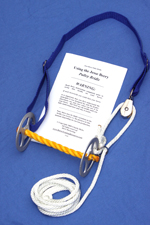
P.S. The results have been nothing short of amazing. The notes like this that
we get from those who use the pulley bridle for various problems tell the story:
“I was quite honestly shocked by the result of something so simple.
Over the course of 3 total, 1/2 hour sessions I have made more
progress than the entire 3 years previous. ”
–Scott Johnston
If you have problems with a horse rearing, biting, throwing their head,
stepping away, won’t let you pick up their feet, etc.. then read about
this simple pulley bridle and try it. Used right it works amazingly well.
So you know, these videos show a lot of other
training as well as stopping.
Onward.
Now when your horse is spooked and someone’s pulling
on his reins, pain in the mouth from the reins pulling
him get overridden by the fear of his life being in danger.
It’s like pain doesn’t even exist.
In fact, if you pull harder, the horse may run harder.
That pain can turn into adrenaline and really fire him up.
And here’s a little trick.
If you’re observant, while riding your
horse you will nearly always see his body movements
before he takes off.
For instance, his head may come up. That’s a classic
sign of “Oh my gosh…DANGER!” in the horse’s mind.
That’d be a great time to talk to him and get
his mind directed back to you.
If both his ears are pointing forward because his radar
is locked into that strange sound, talking to him can
get an ear back to you so he pays attention to you
instead of some weed-eating monster.
Also, being quick to turn him in a circle before
freaks out is a good tip.
That gives him something to do and takes his mind
off the spooky object.
And since a horse can only think of one thing at a time,
giving him something positive think about is a great tactic.
2. Training Foundations: Teaching The Basics for Safety and Control
Are you training a colt or have a horse that needs some basic training
so you can ride safely and have complete control?
Trying to ride a horse that is out of control is just dangerous! It
is especially dangerous if you haven’t been around horses much and
aren’t sure what to do when the horse blows up underneath you.
I’ve published a few articles about how dangerous horse riding and
horse handling is. The statistics tell the story – THOUSANDS of
folks get hurt, broken bones, concussions, severe disabilities,
and even die every year.
If you can’t completely control your horse then your taking a risk.
Here’s a few foundational basics that you must be able to do
before your horse is considered safe:
1. Teach the basic commands “Get UP” and “Whoa”
2. Be able to handle your colt or horse on both sides without them
moving or shying.
3. Teach them to come to you and take a bridle or halter without
throwing their heads or moving away.
4. De-spook the horse and teaching the horse to overcome fear
of things flapping in the wind, noises, etc.
5. Be able to safely mount the horse without it moving away.
6. Safely handle the horse without it crowding you.
7. Teach basic reining.
Once you can safely handle your horse and are able to completely
command them, then you can ride safely and go on to more
advanced training.
Would you get in a car and drive off through hills in a car
with no brakes or no steering? Sort of ridiculous, isn’t it?
Why people would get on a horse they can’t stop, can control,
that bucks or rears, shys at everything on the trail, or
that they simply can’t control is beyond me.
It’s nothing less than an accident waiting to happen.
This is exactly why we offer the Jesse Beery Horse Training Course.
Everything you need to know, including curing all those bad habits
and much more, is taught in the complete, 8 volume course.
We offer it in printed books, as downloads, as books on CD, and
even have all 8 volumes as audio books in MP3 format.
The audio books were professionally recorded by the
“Voice of The Outdoor Channel” and sound great.
You owe it to yourself anyone who may be around your horses to do
the proper basic training. See the Beery Course here:
P.S. Remember – the Jesse Beery Illustrated Course in Horse Training also
comes with two bonus books:
“The Arabian Art of Taming and Training Wild Horses” and
“Breaking and Training Colts”.
Both bonus books are great additions to your horse training library.
You can see the entire table of contents for each here:
Just starting out with horseback riding? Need some professional help?
It is normal for anyone just starting out to have lots of questions,
be somewhat fearful and at times confused about how to start
and learn the right way.
That’s why we wrote:
“Horseback Riding: The Complete Beginner’s Guide”
This book takes you as a beginner, who knows nothing about horses,
and gently leads you through all phases of riding, horse care,
grooming and much more.
It completely prepares you for your first real riding lesson s
o you start with knowledge, understanding and confidence when
you mount the horse for the first time.