Horse Training Tips: The ‘Smokin Bacon’ Horse Training Priniciple

In This Magazine Issue:

************************************************************

1. The ‘Smokin Bacon’ Horse Training Priniciple

2. Success With the Jesse Beery Pulley Breaking Bridle

*************************************************************

1. The ‘Smokin’ Bacon’ Horse Training Principle

Here’s Andy Curry’s report from the field about a very important training principle:

Today I wanted to point out a crucial horse training tip.

If you have ever worked with a horse and he gets more and more resistant, there’s a tendency to use our parenting skills.

To the uninitiated, the parenting skills make sense. After all, it’s what you do with your kids, right?

Often, a child that’s resistant gets pressure from the parent to do what the parent says to do.

The more resistance the kid gives, the more pressure the parent gives.

But with horses, that’s a great way to get him to lock up and make him mad.

When that happens, you’re witnessing the ‘Bacon Principle’.

What is the Bacon Principle?

Let me explain.

First, the bacon principle comes from one of our featured trainers.

His name is J.J. Ryberg.

http://www.horsetrainingresources.com/dvd-jjrydberg.html

J.J. says that once a horse gets resistant the he (J.J.) softens WAY up.

Why?

Because too much pressure is applied and the horse doesn’t like it.

J.J. says:

‘It’s like cookin’ bacon. When the bacon smokes you gotta turn down the heat.’

Thus, go slow. Release pressure.

When it starts smokin’, go back to the basics.

http://www.horsetrainingresources.com/dvd-jjrydberg.html

That’s yet another powerful horse training principle – going back to the basics.

Anytime the bacon starts smokin’, go back to what the horse knows. It’ll bring him back to you.

Now this ‘Bacon Principle’ is veddy, veddy, veddy important.

You have to learn to recognize when the pressure is too much.

If you blow it, you won’t teach him anything.

He can get mad. So mad, in fact, you couldn’t get him to do anything.

To learn more about this principle and how to deal with it, check out J.J.’s video at:

http://www.horsetrainingresources.com/dvd-jjrydberg.html

**********************************************************************

2. Success With the Jesse Beery Pulley Breaking Bridle

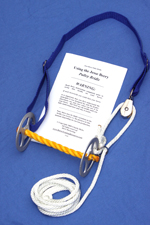
When your horse won’t let you pick up his feet or keeps crowding you or keeps moving when you try and mount…. what do you do?

There’s a whole mess of bad behaviors that lots of horse owners keep putting up with or just can’t cure. If you’re one of them, listen up.

We’ve been making and selling the Pulley Breaking Bridle for quite a while now and have dozens and dozens of letters that folks have written to us thanking us and praising the Pulley Bridle.

Jesse Beery talks about it at length in his Horse Training course.

http://www.horsetrainingresources.com/bridle.html

It is simple yet extremely effective. Many folks said they just couldn’t believe how fast and easy it was to correct multiple bad behaviors in their horses. Here’s an example of one letter by a 29 year veteran farrier:

————————-

“Charlie,

Just got your Pulley Bridle about 3 weeks ago. Man am I impressed! I have been a Farrier for 29 years, seen alot of so called tools of the trade but the Pulley Bridle has them all beat.

Tried it out on Miniature Horses that 8 weeks before had to throw them on the ground to trim, after 4 pulls on the bridle I was able to pick up all 4 feet no problem.

1 week later did a mamoth jack never been done before, tried to work with him a while, ran out of time, put bridle on couple of pulls stood there willing to be handled.

I could go on for ever I guess, but thanks a million.

PS Work with your horse so when the farrier gets there we can get are job do quick and easy.”

— Bob Wallace, Bellefontaine Ohio

————————–

Read about it yourself and get yours. It comes with a 100% guarantee so you have nothing to loose.

http://www.horsetrainingresources.com/bridle.html

****************************************************************************

That’s it for today… stay safe with your horses…

Charlie
Posted in General, Horse Training Tips, Horse Training Videos | Tagged , , , , , | Leave a comment

Horse Training Tips: Is Your Horse Like a Rabbit?

Is Your Horse Like a Rabbit?

Trainer Andy Curry interviewed and filmed Sam Burrell. Let’s listen to Andy tell describe this session:

Did you know rabbits can see forward and backward…

“at the same time!”

Tis true.

Horses are nearly as adept in their sight as well.

In fact, given patience and training you can get horses doin’ all kinds of cool things.

Most of us don’t aspire to get horses doing things that take years of training.

But what we should all do it is install an Operating System in horses.

What’s an Operating System?

An Operating System is basically the ability to communicate to your horse how you would like him to move his zones.

What do I mean by zones?

Well, you can divide your horse into 4 parts.

The head and neck.

The shoulders.

The rib cage.

And the hindquarters.

We’ll begin communicating how to move starting out with the snaffle bit and our rein effects.

And our aids of communication for the horse come from our hands through the reins, our seat (weight), and our legs.

Now here’s something you should know.

Sam Burrell, one of our trainers shows this in his DVD.

When he did, he commented on how learning this is what gave him breakthroughs in horse training.

In fact, Ray Hunt said to him, “The first thing you need to know is the last thing you’ll find out.”

What Ray meant was “It’s too bad you didn’t know this before because it would’ve made a startling difference in you and horse’s ability at first instead of years later.”

And now YOU know that this is something you should know now.

Why?

Because you’ll kick yourself if you wait to know it later.

So how does it work?

As an overview, you first need to understand the rein effects.

Don’t worry, they’re easy.

The first is the direct rein.

This is a direct rein to the horse.

YOu’ll take it half way to your hip and be able to just see the horse’s eye. This is very important.

On a green horse or one you’re retraining, hold you hand out to the side more so your horse can see it better and know what it means.

The direct rein is used to get lateral flexion. It’s also like a lead rope where you’d lead the horse around just like you would from the ground.

The next is the indirect rein. (aka: Neck Rein)

This has to be taught as a cue through repetition.

And here’s a little tidbit you should know.

It takes, roughly, 300-400 repetitions for a horse to learn a cue. And about 300-400 more to get good at that cue.

Next is the Direct Rein of Opposition.

Here you take one rein straight back to your hip.

Pulling both reins back directly opposes the horse’s forward motion.

This isn’t used much…especially in the beginning.

This is used mostly to flex at the poll and for collection.

And you should know this is not effective in controlling your horse. It’s mostly for communication and should be applied lightly.

Next is the indirect rein of opposition.

This is where you take the rein across the saddle horn to your opposite shoulder. Thus, pick up the right rein and point it to the left shoulder.

Now as you get your horse to go through “Zone” exercises, you’ll be using these Rein Effects.

For instance, Zone one is simply walking in a circle. You’ll use your inside rein and leg.

Walk about a 12 to 15′ circle. Be able to see the horse’s eye. You don’t need to see the whole eye… just be able to see it.

You want your horse going in a circle like a train does on a bent track.

Your inside leg is full of life with touches and releases and life in the hand.

Your outside leg is “Off”.

Use lots of soft touches and releases to keep your horse going in a circle.

You must first teach this at a walk.

Once mastered in the walk, then you can go to a trot and eventually the lope.

Eventually, your horse will flex toward your leg. If you touch the horse on the side with your leg, he should look that way and bend his rib cage away from your leg.

In a nutshell, that’s Zone one exercise.

There are several others, but you get the idea.

If you want to know more, click on the following:

Sam Burrell Horse Training DVD

Remember what Ray Hunt said.

The first thing you need to know is the last thing you find out.

If you don’t know how to do this, you should make the effort to know now because you will eliminate a LOT of frustration.
Stay safe on your horses!

Charlie

Sam Burrell Horse Training DVD

Posted in General, Horse Training Tips, Horse Training Videos, Horseback Riding | Tagged , , , , , | Leave a comment

Horse Training: Fight or Surprise? Reining, Control and Understanding

In This Issue:
**************************************************************
1. How To Check If You’re In For A Fight Or  A Surprise Before You Ride Your Horse

2. Pulley Bridle Does It Again!

**************************************************************
Trainer Andy Curry gives us this report:

How To Check If You’re In For A Fight Or A Surprise Before You Ride Your Horse

Danie Hewlett, a Reining Trainer and Reining Horse Judge,  goes through a process to check a horse’s mindset and his “give” before she even gets on him.

Danie first lunges the horse by having him walk quietly around her.

When she says “Walk”, the horse walks. Not trot.  Not lope.  Walk.

When she says “canter” the horse canters.

And so on.

She’s strict in what she wants and you should be too because it makes your horse better.

Next, she’ll look for stiffness and soreness.

So when they lope off, they should do it easily.

This tells you if they do it freely where some horses will want to kick at you.

If they kick at you, that tells you they’re not in agreement with what you want.

After loping them off, you can see how they handle it.  Some horses will fall out of lead when you speed up, some will throw their head out.

This just tells you where they’re at in their training.

Always remember, check the horse’s other side too.

And some other ground things Danie urges you to check are these.

One, have the horse walk a small circle around you.

Your more in his space.  You want all four feet to move and you want him to stay soft in the face while doing it.

http://horsetrainingresources.com/dvd-daniedoughewlett.html

Next, push on him.  Does he move sideways? If so, that’s good.  Some horses try to kick, bite or run off.  Watch out for the kicking or biting.

When you push on him, you want him to keep moving and moving sideways and then come back into the circle.

Next, check that you can pull both reins and if he backs up softly.

All this will tell you if you can take hold of his face, turn him in a circle, move him with your legs,  and whether or not you’re in for a big fight or surprise when you’re on his back.

All these are crucial to safely and confidently riding a horse.

This is part of what’s in the DVD by Danie and Doug Hewlett.

This DVD is about Reining and is loaded with horse training info.

If you’d like to read about it, click the following:

http://horsetrainingresources.com/dvd-daniedoughewlett.html

Please remember.

Check your horse before you get on to see if he’s gonna argue with you or not.

If he shows he won’t, that’s good.

If he shows he will, then you should fix that before you go for a ride.

http://horsetrainingresources.com/dvd-daniedoughewlett.html

********************************************************************

2. The Pulley Bridle Does It Again!

Scott Johnson sure thinks so:
——————————————————————-
“I was quite honestly shocked by the result of something so simple.

Over the course of 3 total, 1/2 hour sessions I have made
more progress than the entire 3 years previous. ”

–Scott Johnston
——————————————————————-

If you have pesky issues to solve with your horses then try this pulley bridle now.

Read the other testimonials.  Read our no-hassle guarantee.

You can’t loose and have everything to gain….   even your safety, peace of mind and a well-behaved horse!

http://horsetrainingresources.com/bridle.html

*********************************************************************

Ok.. that’s it for now.  As I type this we’re in the middle of a white-out.  The wind is blowing 30 – 50 MPH and I can’t see the barn due to the blowing snow.

Be safe with your horses,

Charlie

P.S. “The Most Successful Horse Training Course in History”.  Thousands of happy horse owners have proven it.  Get your copy of this famous course: “Prof. Jesse Beery’s Illustrated Course in Horsemanship”.

It will save you time, money and give you a safe horse to ride and work
around.  Having a safe horse is really not an option….  start now.

http://horsetrainingresources.com/beery.html

Posted in General, Horse Training Tips, Horseback Riding, Testimonials | Tagged , , , , , , , | Leave a comment