If you’ve been around horses much and around other trainers, you’re
bound to hear some stories about how some trainers, mostly in the past,
would use some pretty abusive methods when training their horses.
The thing is though, methods used such as whipping or
other things to cause harm never accomplishes anything
positive. The horse will most likely end up being a real mess.
We NEVER, under any circumstances, suggest or support any
methods of training that are abusive.
I have witnessed folks trying to physically force a colt into
a horse trailer, completely against his will and resisting 100%
all the way. It wasn’t a pretty site. And the colt went
bananas and tore himself up as he thrashed.
I never want to see anything like that again.
However, we all hit brick walls when training at times and wonder
how to handle situations in the most efficient and effective way.
Sometimes there are things that are hard to teach and you need to
get the attention of the horse to reinforce the training.
Jesse Beery – in his 8 Volume Illustrated Course In Horse Training –
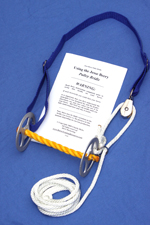
introduces the Pulley Breaking Bridle to be used for many situations.
The bridle is so simple, yet one of the most effective tools
in the whole course.
Throughout the book Beery describes how to use the bridle
to teach and cure such things as picking up their feet for shoeing,
teaching a horse to stand while mounting, teach it not to shy at
items, teaching it to back or to follow, and many other things.
The effectiveness, and the genius of this bridle, is centered around
applying very quick pressure behind the ears where there is an
exposed area of nerves. By making very short pulls on the pulley
bridle it applies pressure in that area and the horse stops
and pays attention.
It is quite amazing how well it works and many folks are still
surprised after using it, even though they have read all the
testimonials of others.
P.S. The Jesse Beery Pulley Bridle is only one of the unique
methods described in Beery’s course. Be sure to read about
the the full Beery horse training course about all the
things you can learn about training your horses.
Trainer Andy Curry is discussing warning labels and horses:
Wouldn’t it be neat if horses came
with warning labels?
After all, things us consumers buy
always have warning labels.
Some warning labels are downright
outrageous.
For instance, on a bottle of hair
coloring there was a warning that said:
“Do not use as an
ice cream topping.”
No,…I’m not joking.
Here’s one that’ll cause you to
puzzle.
It was a warning from a laser pointer.
It said:
“Do not look into
laser with remaining eye.”
Remaining eye????!!
But again, wouldn’t it be neat if
horses came with warning labels?
If they did, would it reduce the
number of accidents?
After all, if you’re getting a horse
that’s been ridden or trained by someone else,
you don’t know what you’re getting – unless
you know who trained and rode.
The only other way I know of is to
evaluate the horse.
But to evaluate, you really need to
know what to look for.
In Doug and Danie Hewlett’s Reining
DVD set, they show some good evaluation techniques.
Sure they’re doing it from a Reining
standpoint, but it just so happens that
it is pertinent to horses no matter the discipline.
For example, how would you like to
know if your horse is in agreement with you?
In other words, if you ask your horse
to do something…does he do it willingly
or is he not happy about it.
If he does it willingly then that is
certainly a good sign.
You have just evaluated that his mind-
set is that of willingness. Another quick
test or two would be advised to confirm it.
That’s good.
But if he’s not happy about doing some- thing
you ask of him, then that’s a sign that he may
do what HE wants and he doesn’t care about
what you want.
When you’re on his back, that’s NOT
what you want.
One way to tell if your horse is
willing or not is to ask him to lope in
either the round pen or while lungeing.
When he lopes he may do it freely
or…he may want to kick at you.
If he kicks at you then you know he’s
not in real agreement with what you want.
Would you want to get on a horse that’s
not in agreement with you?
No!
If you’re an experienced rider and trainer you may.
But you may not either.
I know trainers who refuse to get on
other people’s horses because they don’t
know the horse.
Does that mean they’re not worth their
salt?
No.
It means they’re thinking about their
safety and they’ve been hurt enough times that
they aren’t going to risk injury un-necessarily.
Thus, it’d be neat if horses came with
warning labels.
But since they don’t, you should really know
some evaluation techniques.
Doug and Danie Hewlett show some
valuable evaluation techniques in their Reining DVD.
If you feel you need to bone up on your safety by
knowing more about evaluating horses, just click
the following to know more: Get Your Hewlett Reining DVD
Oh.
Here’s one more warning label I thought
you’d get a kick out of.
Once you read it, you’ll know exactly
why it was put on the product.
1. Would You Want Your Horse To Stop If This Happened?
Here’s Andy Curry with some good info:
In rodeo competitions, the rider chases a calf.
The horse zooms up next to the calf,
and at the right moment, the cowboy slides off his horse,
onto the calf, and the wrestling match begins.
The horse is trained to do run up to
and along side the calf so the cowboy can do his thing.
But what if you’re not as good at riding a horse as these guys?
What if you have a son or daughter who
you worry about falling off the horse and the horse doesn’t stop?
That would be especially bad if a foot was caught in the stirrup.
Ouch.
Would you rather have a horse taught to stop or
slow down if you’re falling off?
Why would you want that?
Well, if you’re not a rodeo-er or into
Dressage, etc., then chances are you’re more
into trail ridin’ and easy goin’ stuff.
T’ain’t nothin’ wrong with that. In fact, that’s a
very big portion of the horse industry today.
So if you’re not an experienced rider, break easier
‘n you used to, and want your horse to stop if you fall
off or maybe even slow down if he feels you slipping,
that can be done.
Diana Quintana, one of featured trainers,
teaches that very thing to horses.
She’ll take a ‘deflated innertube’
(with the stem removed) and put it on a horse.
She’ll start by having the horse walk around with it on.
Not trot or lope…walk. (I might add the horse may need
to get used to it being on his back first. You can’t always throw it on and go.)
Anyway, once the tube is on, have the horse walk a calm, steady pace.
As he does, watch for the inner tube to come off… because it will.
As it starts to slip, the horse will notice it.
That’s the horse’s cue…when it starts to slip.
That mimics a rider starting to slip off.
Then when the tube hits the ground, stop the horse.
And once it’s on the ground around the horses feet,
you want him to accept it and not freak out about it.
You want him calm and cool about it.
Why?
Because you always want your horse to remain calm and cool
regardless of the situation. That way, you don’t have to fight
a thousand pounds of out-of-control muscle. Instead, it’s taught self control.
When you get him doing this well at the walk then you
can go to the trot – but not until then.
Now there’s a little more to it than what I told you because
words don’t do it justice, some things ought to be seen for clarity.
But you get the gist.
And if you haven’t yet seen Diana’s video, you might take
a look at it. To read about it, click the following:
I get many, many emails from folks who just don’t know
what to do to fix all kinds of problems they’re having
with their horses.
(By the way – there’s just no physical way I can answer
all of them – so if you didn’t get a response from me, I apologize.
There just isn’t enough time in the day.)
A lotta of the problems relate to not learning the basics
of controlling your horse.
It all starts with understanding how your horse learns, how his
brain works and how you fix good – or bad – habits into his brain.
However, there is good news! I’m bettin’ that ANY problem you
could come up with in ANY horse has already been figured out and
fixed by trainers, even a century or more ago.
After years and years of proven horse training methods and
thousands of horses fixed from every problem you can imagine,
effective solutions exist that any horse owner can take advantage of.
Think your problem is unique? It probably isn’t. The nature of
the horses and their problems hasn’t changed in hundreds, if not
thousands of years.
Read about the Jesse Beery Course in Horse Training. If his course
doesn’t directly address the problems you are having and/or
doesn’t provide effective methods to fix the problems then
send it back.
However, what you’ll learn in the process is life-changing.
You’ll get a better understanding of any horse you handle
or ride and will know how to address almost any issue that
comes up with your horses. From starting a colt to fixing
all kinds of bad habits… YOU will have control.
Click the link below and read about it for yourself: Jesse Beery Horse Training Course
Ok.. that’s it for today…
work with your horses – but do it safely.
Charlie
++++++++++++++++++++++++++++++++++++++++++++++++++++
Want to buy your first horse and don’t want
to make the wrong choice?
This complete horse-buying manual helps you find,
select and buy the right horse.
You can save thousands of dollars by getting the
right, healthy, horse suited for the style of
riding you want.
But it isn’t always obvious and some folks just
don’t tell the whole truth when showing you their
horses for sale.
If you don’t have the experience then you need
this manual!